Posts

Showing posts with the label heavy metals

What’s Really in a Haboob? The Hidden Health Risks of Desert Dust Storms

Image
 When a wall of rust-colored dust rolls across the desert at 60 mph, it’s hard not to be awestruck. In the American Southwest, Saudi Arabia, Iraq, and other arid regions, these massive dust storms are called “haboobs” (from the Arabic word habūb, meaning “blowing furiously”). They’re undeniably photogenic, but what’s actually inside that choking cloud? A haboob isn’t just “clean” sand. It’s a toxic soup of microscopic particles and biological material that can travel hundreds or even thousands of miles. Here’s what scientific studies have found floating around in these storms: 1. **Fine Particulate Matter (PM10 and PM2.5)**      The biggest health threat. PM10 particles are ≤10 micrometers (about 1/7th the width of a human hair), and PM2.5 are ≤2.5 micrometers—small enough to lodge deep in your lungs and even cross into your bloodstream. Haboobs routinely push PM2.5 levels 10–50 times above WHO safety guidelines. 2. **Heavy Metals**     ...

What About Industrial and Mining Air Pollution? The Problem We Keep Ignoring in 2025

Image
 Air pollution from factories, power plants, refineries, and mines doesn’t get the same headlines as car exhaust or wildfire smoke. While cities celebrate “blue-sky days” and electric vehicle adoption climbs, industrial and mining emissions quietly keep shortening lives and warming the planet. Let’s stop pretending this is a solved problem. #### Where the Pollution Actually Comes From 1. Coal and gas-fired power plants (still 60%+ of global electricity in many countries)   2. Steel, cement, and chemical manufacturing   3. Non-ferrous metal smelting (copper, nickel, zinc, lead)   4. Artisanal and large-scale gold mining (mercury vapor)   5. Oil & gas extraction and refining (methane leaks, benzene, H₂S)   6. Coal mining (fugitive methane, coal dust)   7. Phosphate and bauxite processing (fluoride and alumina dust) The World Health Organization estimates that industrial sources alone contribute to roughly 4.2 mi...

Man-Made and Natural Poisons That Contaminate the Ground

Image
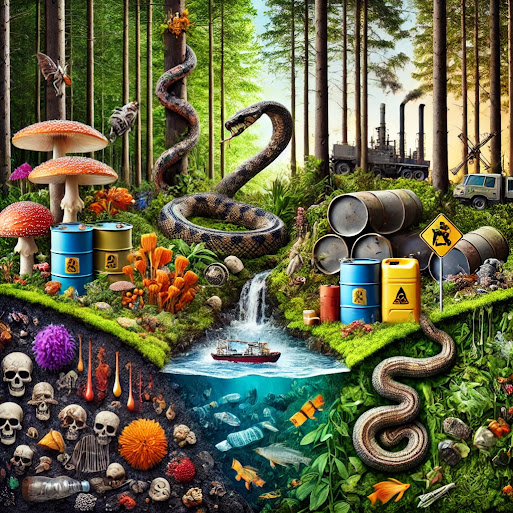
  Healthy soil is essential for sustaining plant life, filtering water, and supporting ecosystems. However, both man-made and natural poisons threaten soil quality and safety. Understanding these contaminants and their impact can help develop sustainable solutions for reducing soil pollution. Explore the contrast between natural and man-made poisons in the earth, from toxic plants and venomous creatures to industrial pollution and chemical waste Man-Made Poisons in Soil 1. Pesticides and Herbicides Agricultural chemicals such as glyphosate, atrazine, and neonicotinoids are widely used to control pests and weeds. However, these compounds can persist in soil, harming beneficial organisms, leaching into groundwater, and disrupting ecosystems. 2. Heavy Metals Industrial activities, mining, and improper waste disposal introduce heavy metals like lead, arsenic, mercury, and cadmium into the soil. These toxic elements accumulate over time, poisoning plants and entering the food chain...